So we've gotten numerous emails about the access medicine and as of currently we don't have to complete the modules anymore for our core rotations! It appears many people are having difficulty signing in but I wanted to talk about the other resources that it contains that I didn't even know existed that I found while clicking around.
The only real helpful thing I found was for those taking Pharmacology on the island, you have access to Katzung & Trevor's Pharmacology: Examination & Board Review. I used this book a lot in Pharm because there are questions at the back of each chapter. The book is on reserve at the library but you have to leave it there so this allows you to access it at home! They have the chapters but they also have the interactive self assessment where you can do all the questions!
There were also some other not so popular books there if you're interested.
Happy studying!
Sunday, May 1, 2016

Sunday, April 24, 2016
Surgery Core Rotation
At the end of March, I completed my surgery core rotation in Waterbury, CT at St. Mary's Hospital. This was by far my most difficult rotation, not because it challenged me mentally but because it challenged me physically. For 3 months I reported to the hospital around 4:30-4:45am and didn't leave the hospital until 6-6:30, sometimes later, 6 days a week. It was very difficult to come home and then study and even the 1 day we had free a week, all I wanted to do was sleep. The fact that it was winter was a good and bad thing. Good because I wasn't envious of others for getting to be outside, because it wasn't nice anyways but bad because there was very little daylight. I went to the hospital when it was dark and returned home when it was dark. Never really got to see what Waterbury looked like but from what I've heard there's not much to look at anyways :)


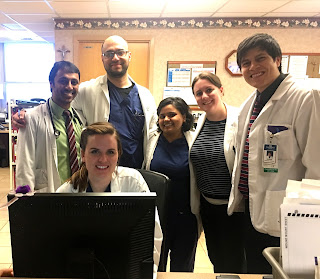
The rotation consisted of 11 other students from 4 different caribbean schools, 2 being PA students. This was the first rotation I had the opportunity of working directly with students from other schools which I met some great new friends. 12 students sounds like a lot but 2 were always on the night shift which left 10 others to cover the surgery board each day and there were almost always enough surgeries to go around.

One of my best friends throughout the rotation!
In the mornings, we prepared for morning rounds with the residents then went to surgery or helped with floor work then afternoon rounds. One benefit of this program is you get to see a lot of different surgeries. They primarily do laparoscopic and robotic surgeries with occasional open surgeries. You are working with the General Surgery team so get to see appendectomies, cholecystectomies, hernia repairs, and amputations galore but also colo-rectal surgeries such as hemicolectomies, hemorrhoidectomies and low anterior resections. There is multiple bariatric surgeons so I saw gastric sleeves and gastric bypass surgeries. There are also many breast surgeons so you will see lumpectomies and mastectomies with reconstruction. You are get to sit in on cardiothoracic surgeries such as valve repairs and replacements, coronary bypass surgeries and aortic aneurysm repairs. They also have many vascular surgeries so you will see fem-fem bypasses, angiograms w/ angioplasty, carotid endarterectomies and AVF formations. Some friends even got to see some neuro surgery for subdural hematoma evacuation and urological surgeries. I was very grateful for the exposure I got. While a majority of these surgeries you are scrubbing, you usually don't get to participate much as the residents are helping a majority of the time. They would let you hold retractors, cameras and maybe even throw a few closure sutures.

I had a few cool experiences in the OR. Having a surgeon (who is not normally too nice) say that he wanted me to be in everyone of his cases because I held the camera better than any other medical student he had, made me happy! Also getting to help close the chest after an open heart surgery (even though we NEVER get to scrub in on heart cases). Those were God's way of telling me to keep pushing onward even though I know you're tired :)
On the floors we would do a lot of wound dressings, wound debridements, placement of NG tubes and I&Ds. Every Wednesday was academic days where we would have lectures, cancer conference and sim labs. We had labs on Central line placement, chest tube placements and suturing. All were very helpful things that we had not gotten in our Maine semester so I enjoyed it. We also got called to all traumas and suture opportunities in the ER.

Our Team!
Studying for the Shelf:
Everyone will say the Surgery shelf is all Internal Medicine, ummm yes it is because surgery is just operating on medical conditions. They aren't going to ask you specific procedure related questions on the exam so they have to ask questions over the pathophysiology etc. It just makes sense. Learn IM but also postoperative complications.
Books I used: I used surgical recall through the rotation for pimping in the OR. I knew the surgeries I would have the next day, so I just read that chapter quickly the night before to refresh my memory. For the shelf, I used Pestana's surgical notes. The book not the pdf document. The pdf document is a bunch of cases, the book is short descriptions of a bunch of conditions. And as always I did the uWorld questions.
For the rotation here, we had weekly quizzes over chapters in Essentials of General Surgery. It's a good book to reference if you want a little more information than what Pestana's offers.
Operative Anatomy is a great resource for the step-by-step of each procedure. NOT necessary for the shelf but I liked to briefly skim it before each surgery to at least have a generalized idea of what was happening. It included a lot of anatomy which the surgeons would pimp on in the OR too.
Monday, April 18, 2016
How to register for Step 2 CK
Hello everyone!
Just a quick post about registering for Step 2 CK! I'm finally biting the bullet and registering.
1. Go to ecfmg and sign into IWA.
2. Under Begin New Application click "USMLE Step 1, Step 2 CK and/or Step 2 CS"
3. Select "Step 2 CK"
4. Choose your eligibility period
5. Complete Application
Lastly, spend over $800 for the exam :(
That's it!! Pretty easy now you just wait for the confirmation from ECFMG and that will give you permission to schedule the exam!
Just a quick post about registering for Step 2 CK! I'm finally biting the bullet and registering.
1. Go to ecfmg and sign into IWA.
2. Under Begin New Application click "USMLE Step 1, Step 2 CK and/or Step 2 CS"
3. Select "Step 2 CK"
4. Choose your eligibility period
5. Complete Application
Lastly, spend over $800 for the exam :(
That's it!! Pretty easy now you just wait for the confirmation from ECFMG and that will give you permission to schedule the exam!
Sunday, February 21, 2016
Hematology Oncology Elective
I've always enjoyed learning about hematology and oncology so decided to do an elective in it. I completed the elective in Ponce, Puerto Rico. I was placed with a physician that had a private office but also went to multiple hospitals to see patients as well. The nature of hematology, oncology is that it is a lot of counseling and follow up appointments just to check on how people are doing. The rotation itself wasn't extremely hands on because the physician adjusts treatment plans based on how the patient is responding to it. I was able to see a lot of bone marrow biopsies which was something new I had not seen before. It was a great learning experience because as the physician was describing things to the patients, I was listening and learning right along with them. The physician I rotated with also did clinical research which allowed me to see how that process works. He also presented at many events such as companies raising awareness about different types of cancers and risk factors.
One main goal of going to Puerto Rico for some rotations was to improve my medical spanish and that I did. Even though I studied Spanish throughout college, I never learned words like antibody or platelet. I'm much more confident in speaking Spanish to my patients and being able to understand them as well. I believe that everyone should be able to receive the same medical care regardless of the language they speak, but without being able to understand the patient this is very difficult. Most hospitals have a translator phone or interpreters that come but nothing replaces being able to connect with your patient with the same language. This is why I am so thankful that I speak 2 languages!
One main goal of going to Puerto Rico for some rotations was to improve my medical spanish and that I did. Even though I studied Spanish throughout college, I never learned words like antibody or platelet. I'm much more confident in speaking Spanish to my patients and being able to understand them as well. I believe that everyone should be able to receive the same medical care regardless of the language they speak, but without being able to understand the patient this is very difficult. Most hospitals have a translator phone or interpreters that come but nothing replaces being able to connect with your patient with the same language. This is why I am so thankful that I speak 2 languages!
Sunday, January 17, 2016
Electives in Michigan
These are the electives offered at 2 hospitals in Michigan.
Electives at McLaren Hospital
Electives at DMC Sinai-Grace Hospital (Given on a first come first serve basis, no electives available the months of July-October)
Electives at McLaren Hospital
- Anesthesia
- Cardiology
- Emergency Medicine
- ENT
- Gastroenterology
- Hematology/Oncology
- Infectious Disease
- ICU
- Neurology
- Opthalmology
- Osteopathic Manipulative Medicine
- Ortho
- Pain Management
- Pulmonary
- Radiology
Electives at DMC Sinai-Grace Hospital (Given on a first come first serve basis, no electives available the months of July-October)
- Cardiology
- Gastroenterology
- ICU (Medicine)
- ICU (Surgery)
- IM Sub I
- Nephrology
- Pulmonary
- Rheumatology
- Trauma Surgery
Wednesday, January 13, 2016
Scheduling Electives
So I had a suggestion to write about the process of scheduling electives! By the way, if anyone has suggestions on other topics, let me know! Go to the Contact Me tab or comment below!
How the elective process works is first you need to decide which electives you would like to do, when you would like to do them and where. You can do electives at affiliated hospitals which means that our school already has an agreement with them and the clinical department does all the work for you basically. These spots are mostly the same as where we can our core rotations offered which you can see a list of those here. You can also set up electives by yourself in "non-affliliate" hospitals. I will describe both processes.
Affiliated Electives
For a not so complete list of electives that our school offers, I wrote a post of how to access the list here. Another great resource is the facebook group for clinical students (you can not be apart of the group until you pass Step 1). Many people ask about where people suggest doing a certain elective and your peers are the best to get advise from. Calling the clinical department is always helpful so they can tell you what's available. Don't just call the clinical department for all electives though, have an idea of some you are interested in and go from there! When I receive information about what electives are offered in certain hospitals I try to post it on the blog as well.
Once you decide which elective you would like to do, you contact the clinical department and give them dates you would like to complete it. Sometimes they give you a contact name of a coordinator at the hospital to email directly about availability or sometimes they email the coordinator. Once you determine the timing is good, there is usually some paperwork sent to you and then it should be added to your Clinical Schedule on the portal! Make sure to check this often to make sure your electives and cores are placed on the schedule with the correct dates and locations.
Non-affiliate Electives
One way to score non-affiliate electives is by applying online to specific hospitals. Google any hospital you're interested in going to, along with "visiting medical student rotations" and it should take you to the page to see what's offered. Always read what's required to apply. UMHS is not LCME accredited (the accreditation for U.S. medical schools), many large university hospitals require visiting students to come from LCME accredited schools so it's not worth applying. Some applications have fees involved which you have to cover to apply. Some programs just include an email address of a coordinator if you are interested in doing a rotation there. Almost all applications require the signature of the Dean before applying. Print out the application, fill it out except the dean part and send it to the clinical coordinator. You must also fill out this form with every application you wish for them to send. ALWAYS follow up in a week to make sure someone is working on it!
Another way to get non-affiliated electives is by knowing a doctor who would be willing to take you on as a student or just by contacting smaller hospitals to see what's offered. I happened to met a physician on a tour in Washington D.C. from my home state and she said she would get me into electives at the hospital she works at. It's really about who you know. Connections get you a long way.
Once you have confirmed an elective with a hospital we are not affiliated with, you must get our school's permission to complete it. This involves sending the confirmation email received saying that you can do the rotation to the clinical coordinator along with any paperwork the hospital is asking you to complete. Many hospitals require the school to fill out part of the application and send it in. Complete all of your portions on the application and send it to the school to complete the rest. The clinical dean must approve all non-affiliate rotations.
Along with sending the email you must also log into the portal system, on the left hand side find "Change in Clinical Schedule Request" and click on it. Complete the Section that says "Please Add the Following Rotation to my Clinical Schedule". Give the department a few days then call to make sure they received it. This all must be done prior to 30 days before the start of the elective!!
So this was a crash course on how to schedule electives, if you have any questions let me know and happy scheduling!
How the elective process works is first you need to decide which electives you would like to do, when you would like to do them and where. You can do electives at affiliated hospitals which means that our school already has an agreement with them and the clinical department does all the work for you basically. These spots are mostly the same as where we can our core rotations offered which you can see a list of those here. You can also set up electives by yourself in "non-affliliate" hospitals. I will describe both processes.
Affiliated Electives
For a not so complete list of electives that our school offers, I wrote a post of how to access the list here. Another great resource is the facebook group for clinical students (you can not be apart of the group until you pass Step 1). Many people ask about where people suggest doing a certain elective and your peers are the best to get advise from. Calling the clinical department is always helpful so they can tell you what's available. Don't just call the clinical department for all electives though, have an idea of some you are interested in and go from there! When I receive information about what electives are offered in certain hospitals I try to post it on the blog as well.
Once you decide which elective you would like to do, you contact the clinical department and give them dates you would like to complete it. Sometimes they give you a contact name of a coordinator at the hospital to email directly about availability or sometimes they email the coordinator. Once you determine the timing is good, there is usually some paperwork sent to you and then it should be added to your Clinical Schedule on the portal! Make sure to check this often to make sure your electives and cores are placed on the schedule with the correct dates and locations.
Non-affiliate Electives
One way to score non-affiliate electives is by applying online to specific hospitals. Google any hospital you're interested in going to, along with "visiting medical student rotations" and it should take you to the page to see what's offered. Always read what's required to apply. UMHS is not LCME accredited (the accreditation for U.S. medical schools), many large university hospitals require visiting students to come from LCME accredited schools so it's not worth applying. Some applications have fees involved which you have to cover to apply. Some programs just include an email address of a coordinator if you are interested in doing a rotation there. Almost all applications require the signature of the Dean before applying. Print out the application, fill it out except the dean part and send it to the clinical coordinator. You must also fill out this form with every application you wish for them to send. ALWAYS follow up in a week to make sure someone is working on it!
Another way to get non-affiliated electives is by knowing a doctor who would be willing to take you on as a student or just by contacting smaller hospitals to see what's offered. I happened to met a physician on a tour in Washington D.C. from my home state and she said she would get me into electives at the hospital she works at. It's really about who you know. Connections get you a long way.
Once you have confirmed an elective with a hospital we are not affiliated with, you must get our school's permission to complete it. This involves sending the confirmation email received saying that you can do the rotation to the clinical coordinator along with any paperwork the hospital is asking you to complete. Many hospitals require the school to fill out part of the application and send it in. Complete all of your portions on the application and send it to the school to complete the rest. The clinical dean must approve all non-affiliate rotations.
Along with sending the email you must also log into the portal system, on the left hand side find "Change in Clinical Schedule Request" and click on it. Complete the Section that says "Please Add the Following Rotation to my Clinical Schedule". Give the department a few days then call to make sure they received it. This all must be done prior to 30 days before the start of the elective!!
So this was a crash course on how to schedule electives, if you have any questions let me know and happy scheduling!
Monday, December 7, 2015
Halfway Point
Well I am officially halfway through my clinicals = I'm in my 4th year! Things I've learned over this time:
- I've gone back to back with my rotations with a few weeks here and there. I would recommend doing the same! On the same note, you get burned out pretty easily. It has been nice to squeeze some electives in between my cores to give me a "break." Electives don't have shelves so they are usually a little more laid back and you can focus more on studying for Step 2.
- Schedule your electives early, especially if you want electives at non affiliate locations (aka hospitals our school doesn't necessarily have relationships with, and you have to apply for or know a doctor who is willing to take you on). Most hospitals start scheduling May 1st for the entire year. So if you want a rotation in March, you have to apply the May before that. Also keep in mind that some hospitals don't let us apply because you have to be from a LCME accredited school, which we are not at this time. Look at the hospital's website for visiting students to see if you are eligible or not.
- Study everyday! I know Step 2 seems like a long ways away but it will sneak up and the more times you go over the material, the more it will stick!
- Be willing to move around if need be, even though it is tiring moving all the time, I have loved it! I've gotten to explore so many new places and once you're a doctor you won't have the time to travel as much so do it now! :) I went to Augusta (nothing to really explore there but the rotations were good), Atlanta (lots to explore), Puerto Rico (the most beautiful place), Connecticut and Wyoming to come!
- Your Background Check and Drug Screen expire after one year so you have to redo it. Be prepared for this, I was not informed and then had to do it very quickly to start my next rotation.
- For OBGYN electives your choices are Baltimore, Augusta or Atlanta, Michigan or Puerto Rico.
This is all that I can think of now but I'm sure the list will continue to grow!
Subscribe to:
Posts (Atom)